
Introduction: The AI Reliability Problem
Modern AI systems powered by LLMs are powerful—but unpredictable. The same input can produce different outputs, making reliability a major concern for teams deploying AI in production.
This unpredictability leads to:
- Inconsistent user experiences
- Hallucinated or incorrect outputs
- Compliance and security risks
As enterprises increasingly rely on AI, the question is no longer “Can we build AI?” but “Can we trust it?”
This is where an AI Assurance Platform becomes critical.
Contents
- 1 The Problem: Why LLMs Fail in Production
- 2 What is an AI Assurance Platform?
- 3 Pillar 1: LLM Testing
- 4 Pillar 2: AI Guardrails
- 5 Pillar 3: LLM Observability
- 6 Why These Must Be Unified
- 7 How Trusys AI Solves This
- 8 Benefits for Enterprises
- 9 Conclusion: The Future of AI is Controlled
- 10 SEO Meta Details
- 11 FAQs
The Problem: Why LLMs Fail in Production
Despite rapid advancements, LLMs are inherently non-deterministic systems. This introduces several real-world challenges:
1. Non-Deterministic Outputs
Even with identical prompts, outputs can vary—making testing and validation difficult.
2. Hallucinations
LLMs can generate confident but incorrect responses, leading to misinformation and business risks.
3. Lack of Visibility
Traditional monitoring tools don’t provide deep insights into prompt-response behavior.
4. Security & Compliance Risks
Unfiltered outputs can expose sensitive data or violate policies.
Without a structured approach, scaling AI safely becomes nearly impossible.
What is an AI Assurance Platform?
An AI Assurance Platform is a unified layer that ensures AI systems are reliable, safe, and observable throughout their lifecycle.
Unlike traditional monitoring tools, it goes beyond infrastructure metrics and focuses on:
- AI behavior validation
- Output correctness
- Policy enforcement
- Continuous monitoring
In short, it transforms AI from a black box into a controlled, measurable system.
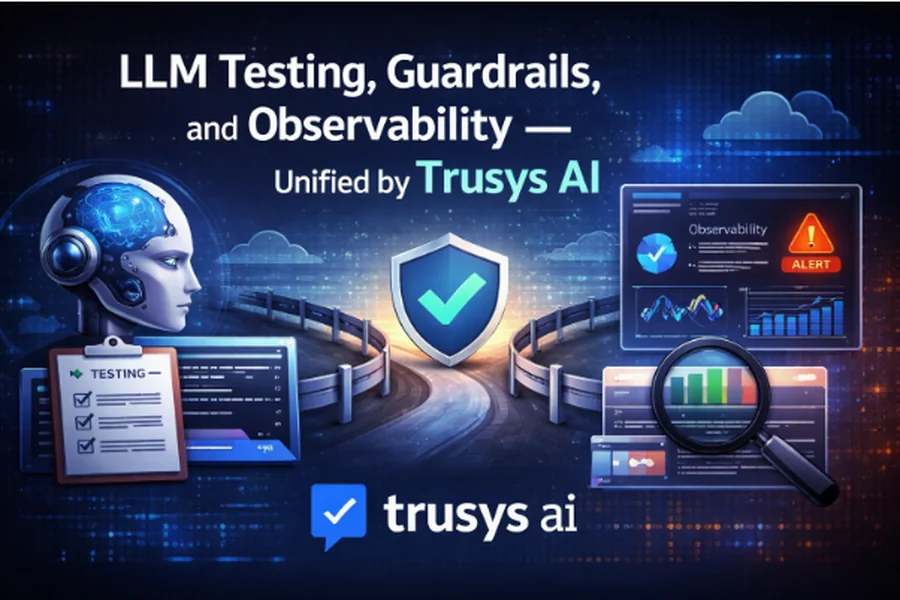
Pillar 1: LLM Testing
LLM testing ensures your AI works as expected before it reaches users.
Key Capabilities:
- Pre-deployment validation of prompts and models
- Regression testing to detect unexpected changes
- Edge case evaluation for robustness
Without proper testing, every AI deployment becomes a gamble.
Pillar 2: AI Guardrails
AI Guardrails act as real-time safety layers that control AI behavior.
What They Do:
- Validate inputs and outputs
- Enforce business and compliance policies
- Prevent harmful or irrelevant responses
Think of guardrails as runtime protection for your AI systems.
Pillar 3: LLM Observability
Observability provides visibility into how your AI behaves in production.
Core Functions:
- Logging prompts and responses
- Tracing model behavior
- Detecting anomalies and failures
- Creating feedback loops for improvement
Without observability, debugging AI systems becomes guesswork.
Why These Must Be Unified
Most teams use separate tools for testing, guardrails, and monitoring. This fragmented approach leads to:
- Gaps in visibility
- Increased operational complexity
- Delayed issue detection
- Higher risk of failures
A unified AI Assurance Platform eliminates these silos and provides end-to-end control across the AI lifecycle.
How Trusys AI Solves This
Trusys AI brings everything together into a single, powerful AI Assurance Platform—designed for enterprise-grade AI systems.
With Trusys AI, you get:
- Integrated LLM Testing for pre-deployment validation
- Real-time Guardrails to control every input and output
- Deep Observability for full visibility into AI behavior
- Continuous Monitoring to detect and fix issues instantly
Unified AI Workflow:
User Input → Guardrails Layer → AI Model → Guardrails → Observability → Action
This unified approach ensures:
- Predictable AI behavior
- Reduced risk in production
- Faster iteration cycles
- Strong compliance and governance
Trusys AI doesn’t just help you build AI—it helps you control it in real time.
Benefits for Enterprises
Adopting an AI Assurance Platform like Trusys AI delivers tangible business outcomes:
Faster Deployment
Ship AI features confidently with robust testing and validation.
Reduced Risk
Minimize hallucinations, policy violations, and unexpected outputs.
Improved Reliability
Ensure consistent performance across all use cases.
Stronger Compliance
Meet enterprise and regulatory requirements with built-in controls.
Increased Trust
Build AI systems users and stakeholders can rely on.
Conclusion: The Future of AI is Controlled
As AI adoption grows, trust becomes the differentiator.
Organizations that succeed will not be the ones who build the most AI—but the ones who can test, control, and observe it effectively.
A unified AI Assurance Platform is no longer optional—it’s essential.
With Trusys AI, you can move from:
Experimentation → Production
Chaos → Control
Risk → Reliability
SEO Meta Details
Meta Title:
AI Assurance Platform for LLM Testing & Guardrails | Trusys AI
Meta Description:
Discover how Trusys AI unifies LLM testing, guardrails, and observability into a powerful AI Assurance Platform for reliable AI systems.
Suggested URL Slug:
ai-assurance-platform-llm-testing-guardrails-observability
FAQs
1. What is an AI Assurance Platform?
An AI Assurance Platform ensures AI systems are reliable, safe, and observable by combining testing, guardrails, and monitoring into one unified solution.
2. Why is LLM testing important?
LLM testing helps validate AI behavior before deployment, reducing risks like hallucinations and inconsistent outputs.
3. What are AI guardrails?
AI guardrails are real-time controls that enforce policies and prevent unsafe or incorrect AI responses.
4. What is LLM observability?
LLM observability provides visibility into AI behavior through logging, tracing, and monitoring outputs in production.
5. How does Trusys AI help enterprises?
Trusys AI offers a unified AI Assurance Platform that integrates testing, guardrails, and observability to ensure safe and reliable AI deployment at scale.