
Bike and motorcycle safety should always be a top priority, but accidents can still happen despite your best efforts. From navigating insurance claims to establishing liability, bike accident litigation involves numerous challenges that can be overwhelming. If you’ve been involved in a bike accident, understanding these hurdles is crucial for achieving a fair outcome.
Dive into this guide to uncover the key legal challenges you might face and discover how a personal injury lawyers in Virginia
can help you navigate the complex legal situation and secure the justice you deserve.
Contents
1. Establishing Liability in Bike Accident Cases
To establish fault in a bicycle accident litigation, one must provide evidence in the form of witness testimony or traffic cameras that show the driver breached his duty of care. If there was a driver who failed to yield and caused a collision, you would need to provide crystal-clear evidence to show this was the fault of the driver.
Once the fault is established, the other challenge is working through insurance claims, since insurance companies usually try every tactic to minimize their payout.
Comparative Negligence :
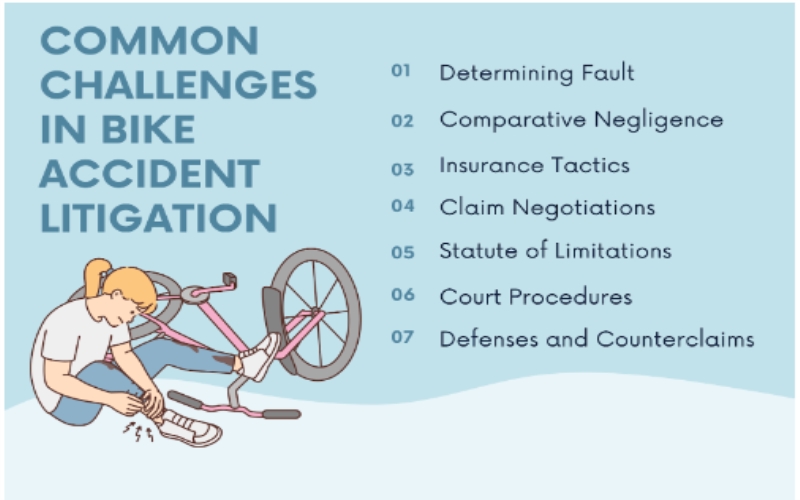
In comparative negligence states, if both a bicyclist and a driver are at fault, the bicyclist’s damages will be reduced proportionally. For instance, if a bicyclist fails to signal when making a turn, his or her award may be reduced in proportion to his or her percentage of fault. Understanding this can help you prepare to refute claims of comparative liability and ensure adequate compensation.
2. Dealing with Insurance Companies
Insurance companies often use various tactics to minimize the amount awarded in a claim regarding a bike accident. They can deny the seriousness of your injuries, liability on their part, or make quick lowball settlements. Be aware that such tactics exist, so you can better your preparedness when negotiating.
Claim Negotiations
Negotiating with insurers requires patience and careful documentation. You should clearly outline the impact of the accident on your life and avoid accepting a low settlement offer too quickly. For example, if you’ve had an accident in Chesapeake, seek professional legal assistance to navigate the complexities of your claim effectively. A personal injury lawyer chesapeake can handle these negotiations on your behalf, ensuring your rights are protected and helping you achieve a fair settlement.
3. Proving Damages and Injuries
Comprehensive medical records are crucial in bike accident litigation. They serve as evidence of the extent of your injuries, required treatments, and long-term prognosis. Keep all medical records, bills, and follow-up appointment details to support your case.
Economic and Non-Economic Damages
Quantifying damages can be challenging, especially for non-economic factors like pain and suffering. Here is a comparison of economic and non-economic damages in bike accident cases:
| Economic Damages | Non-Economic Damages |
| Medical bills | Pain and suffering |
| Lost wages | Emotional distress |
| Property damage | Loss of enjoyment of life |
| Future medical costs | Permanent disability |
| Rehabilitation expenses | Mental anguish |
| Lost earning capacity | Loss of consortium |
While filing a case regarding a bicycle accident, one of the most important things to consider is the statute of limitations. Each state has an assigned time frame, and if failed, one will lose his right to claim damages. One should not waste more time than he can afford for all legal formalities to fall within the specified time frame.
Bike accident litigation can be complex, involving everything from filing a complaint to potentially attending court hearings. Understanding these steps alone can help alleviate some of the stress associated with dealing with them and help you keep track of what needs to be done to keep your case moving properly.
Attention to considerations of rules and timelines, together with adequate preparation, will go a long way toward the better positioning of your case.
5. Role of Experts
Expert witnesses can make a big difference in proving a case involving a bicycle accident. A few categories under expert testimony include accident reconstructionists, medical experts, and bicycle safety experts. Their testimony has the potential to yield crucial insight into questions of fault and injury severity.
Gathering Evidence
Collecting evidence effectively is vital in bike accident litigation. This includes:
- Photographs of the accident scene
- Witness statements
- Police reports
- Medical records
- Preservation of physical evidence (e.g., damaged bicycle parts)
A thorough approach to evidence gathering can strengthen your case considerably.
6. Challenges with Uninsured Motorists
This may add frustration to your claim, as most times the at-fault driver does not carry insurance coverage or adequate insurance. You may have the option of claiming your insurance, provided you have uninsured motorist coverage, or take it further by seeking compensation through other means, such as a personal lawsuit against the driver.
7. Common Defenses
The defendants in biking accidents may also use defenses such as being outside the traffic rules or acting negligently to be partially at fault for an accident. Handling your case effectively requires understanding these potential defenses and gathering evidence, such as witness statements or traffic footage, to counter them.
8. Counterclaims
The opposing parties may file counterclaims, stating that you, too, are somewhat at fault for the accident. In defending your case, you must show that you had followed the traffic laws and acted responsibly to avoid the accident. Take up each counterclaim and clear it up so that a fair verdict should come in your favor.
Conclusion
Navigating bicycle accident litigation has various hurdles. From establishing liability to negotiating with insurance companies and proving damages, every step must be carefully considered. Remember that each bike accident scenario is unique. If you’ve been in a bike accident, consider speaking with an expert personal injury lawyer to help you manage these challenges and preserve your rights.
FAQs
1. What should I do right after a bike accident?
Go to the hospital or urgent care; take photos of the scene; get witness information; call the police at the scene to report the accident. Say nothing about the fault. Contact a personal injury attorney as soon as possible.
2. How much time do I have to file a bike accident lawsuit?
The length of time differs by state. You would need to look up your state’s statute and move as soon as possible. You would need to check with a personal injury attorney who can outline the specific statute of limitations that applies to your case.
3. Can I get compensation if partly it was my fault in the bike accident?
Yes, in many states. Under comparative negligence laws, you will get compensation reduced by your percentage of fault. However, it depends solely upon what your state has to say about it. An injury lawyer can best relate the exact ways these laws apply to you specifically.